
TMDSAS Personal Statement — Texas MD Rubric
Articulate the convictions and formative experiences that compel you toward a career in medicine, and illuminate how your journey thus far has shaped your readiness to enter the profession as a physician.
- Dimensions6
- Score Range0–5
- Word Count550 - 850
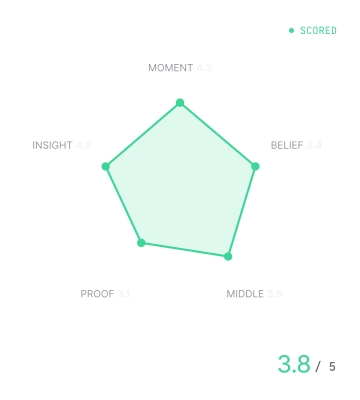
Would your draft pass this rubric?
Check what's true of your current draft. Be honest, the reviewer will be.
- I can point to one specific occasion where it started, not a season, year, or era
- My draft names a belief or behavior I held before, and what replaced it
- There are visible attempts or setbacks between the event and the lesson
- My new understanding is specific enough to quote, it couldn't close someone else's essay
- At least one concrete action after the growth period proves it stuck
Signal building. Over halfway — the missing dimensions are the ones readers weigh hardest.
Get the real scoreWhat Reviewers Look For:
TMDSAS Personal Statement — Texas MD
Clarity of Motivation
Evaluates whether the applicant articulates a specific, personal reason for pursuing medicine rather than a generic or idealized one. Strong responses identify a concrete origin point for the motivation and explain why medicine specifically — not another health or helping profession — is the answer.
Experiential Depth and Reflection
Evaluates whether the applicant demonstrates insight gained from their experiences, not just participation. Strong responses show that the applicant extracted a lesson, changed their understanding, or developed a new perspective as a direct result of the experience.
Clinical Exposure and Insight
Evaluates whether the applicant demonstrates firsthand engagement with clinical environments and shows they understand what the day-to-day reality of being a physician involves. Strong responses reference specific clinical observations or interactions and show the applicant processed what they saw.
Evidence of Competency and Preparedness
Evaluates whether the applicant provides evidence — through experiences, skills, or demonstrated qualities — that they are prepared to enter and succeed in medical training. Strong responses connect specific experiences to competencies like communication, resilience, teamwork, or critical thinking with concrete examples.
Narrative Cohesion and Throughline
Evaluates whether the essay reads as a unified argument about who the applicant is and why medicine is their path, rather than a disconnected list of experiences. Strong responses connect individual anecdotes or experiences to a central theme that runs through the entire essay.
Forward Vision and Physician Identity
Evaluates whether the applicant articulates a coherent sense of the kind of physician they intend to become and why, grounded in their experiences. Strong responses move beyond 'I want to become a doctor' to describe a specific vision of practice, patient population, or value set they aim to embody.
CASPA Technology and AI Essay — PA
Emerging technologies — among them artificial intelligence, telehealth platforms, and wearable medical devices — are fundamentally transforming the landscape of clinical care. How should aspiring physician assistants cultivate the knowledge and judgment necessary to employ these tools with responsibility and discernment, while sustaining the deeply human, patient-centered relationships that define excellent practice — including in settings where access to such technologies remains limited or uneven?
6 DIMENSIONS300-450 WORDSOpen rubricCASPA Personal Statement — Physician Assistant
Compose a focused, authentic statement in your own voice that illuminates the convictions and experiences compelling you toward a career as a physician assistant.
6 DIMENSIONS550-850 WORDSOpen rubricCASPA Life Experiences Essay — PA
Reflect on the personal experiences and distinctive perspectives that have shaped you, and articulate how these qualities would enrich the PA profession. In what ways might your background contribute to the broader imperative of cultivating a healthcare workforce that authentically mirrors the diversity of the nation's population?
5 DIMENSIONS300-450 WORDSOpen rubricAACOMAS Personal Statement — DO
What compels you toward osteopathic medicine, and in what ways have your formative experiences shaped your readiness for this calling?
6 DIMENSIONS600-900 WORDSOpen rubricAMCAS Personal Statement — MD
Use this space to articulate the compelling reasons and formative experiences that have drawn you toward the pursuit of a medical education.
7 DIMENSIONS600-900 WORDSOpen rubricAMCAS Most Meaningful Experiences — MD
This reflection may draw upon formative personal experiences rooted in family history, financial circumstances, community context, educational background, and/or other defining life situations that have shaped your journey.
5 DIMENSIONS150-250 WORDSOpen rubricTMDSAS Personal Characteristics — Texas MD
Holistic review assigns considerable weight to the character and humanity of each applicant, extending well beyond metrics and academic credentials. Illuminate the personal qualities, defining traits, or formative life experiences that you believe would enrich the learning environment and meaningfully contribute to those who will study alongside you.
6 DIMENSIONS300-450 WORDSOpen rubricTMDSAS Optional Essay — Texas MD
In a few carefully chosen sentences, illuminate any distinctive circumstances or formative personal experiences that hold meaningful bearing on your candidacy and have not been addressed elsewhere in your application.
5 DIMENSIONS300-450 WORDSOpen rubric
Frequently asked questions
Quick answers about using the TMDSAS Personal Statement — Texas MD rubric.

Give the draft one more informed pass
Review the draft against its prompt, surface weak spots, and decide what to revise before submission.
Review your first draft