
TMDSAS Personal Characteristics — Texas MD Rubric
Holistic review assigns considerable weight to the character and humanity of each applicant, extending well beyond metrics and academic credentials. Illuminate the personal qualities, defining traits, or formative life experiences that you believe would enrich the learning environment and meaningfully contribute to those who will study alongside you.
- Dimensions6
- Score Range0–5
- Word Count300 - 450
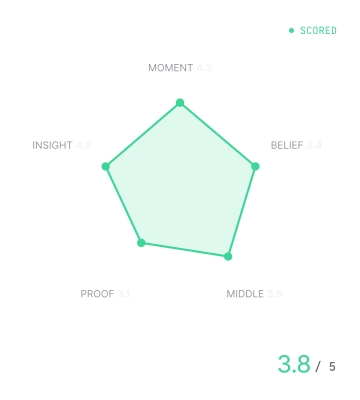
Would your draft pass this rubric?
Check what's true of your current draft. Be honest, the reviewer will be.
- I can point to one specific occasion where it started, not a season, year, or era
- My draft names a belief or behavior I held before, and what replaced it
- There are visible attempts or setbacks between the event and the lesson
- My new understanding is specific enough to quote, it couldn't close someone else's essay
- At least one concrete action after the growth period proves it stuck
Signal building. Over halfway — the missing dimensions are the ones readers weigh hardest.
Get the real scoreWhat Reviewers Look For:
TMDSAS Personal Characteristics — Texas MD
Quality Selection and Presentation
Evaluates whether the applicant chose a quality or characteristic that is specific and substantive rather than generic, and whether it is framed in a way that feels intentional and purposeful. Strong responses name a distinct personal attribute and present it with enough precision that it could not belong to any random applicant.
Experiential Grounding
Evaluates whether the claimed quality or characteristic is substantiated by concrete lived experience rather than assertion alone. Strong responses tie the quality directly to a specific event, context, or pattern of experiences that makes the claim believable and earned.
Contribution Clarity
Evaluates whether the applicant explicitly articulates how their quality or experience will enrich the educational environment of peers, faculty, or the broader medical community. Strong responses make a direct, credible case for the value they bring to others—not just to themselves.
Interpersonal Dimension
Evaluates whether the applicant demonstrates awareness of how they function within groups, learning communities, or collaborative settings. Strong responses show evidence of relational intelligence—how the applicant interacts with, supports, challenges, or learns from others.
Self-Awareness and Authenticity
Evaluates whether the applicant demonstrates honest, nuanced understanding of themselves—including complexity, tension, or growth—rather than projecting a polished or idealized self-image. Strong responses acknowledge difficulty, contradiction, or evolution in a way that reads as genuine.
Distinctiveness and Memorable Identity
Evaluates whether the essay leaves a clear and specific impression of who this person is—distinct from the thousands of other applicants who share surface-level demographics or experiences. Strong responses produce a profile that is recognizable, particular, and unlikely to be confused with anyone else.
CASPA Technology and AI Essay — PA
Emerging technologies — among them artificial intelligence, telehealth platforms, and wearable medical devices — are fundamentally transforming the landscape of clinical care. How should aspiring physician assistants cultivate the knowledge and judgment necessary to employ these tools with responsibility and discernment, while sustaining the deeply human, patient-centered relationships that define excellent practice — including in settings where access to such technologies remains limited or uneven?
6 DIMENSIONS300-450 WORDSOpen rubricCASPA Personal Statement — Physician Assistant
Compose a focused, authentic statement in your own voice that illuminates the convictions and experiences compelling you toward a career as a physician assistant.
6 DIMENSIONS550-850 WORDSOpen rubricCASPA Life Experiences Essay — PA
Reflect on the personal experiences and distinctive perspectives that have shaped you, and articulate how these qualities would enrich the PA profession. In what ways might your background contribute to the broader imperative of cultivating a healthcare workforce that authentically mirrors the diversity of the nation's population?
5 DIMENSIONS300-450 WORDSOpen rubricAACOMAS Personal Statement — DO
What compels you toward osteopathic medicine, and in what ways have your formative experiences shaped your readiness for this calling?
6 DIMENSIONS600-900 WORDSOpen rubricAMCAS Personal Statement — MD
Use this space to articulate the compelling reasons and formative experiences that have drawn you toward the pursuit of a medical education.
7 DIMENSIONS600-900 WORDSOpen rubricAMCAS Most Meaningful Experiences — MD
This reflection may draw upon formative personal experiences rooted in family history, financial circumstances, community context, educational background, and/or other defining life situations that have shaped your journey.
5 DIMENSIONS150-250 WORDSOpen rubricTMDSAS Personal Statement — Texas MD
Articulate the convictions and formative experiences that compel you toward a career in medicine, and illuminate how your journey thus far has shaped your readiness to enter the profession as a physician.
6 DIMENSIONS550-850 WORDSOpen rubricTMDSAS Optional Essay — Texas MD
In a few carefully chosen sentences, illuminate any distinctive circumstances or formative personal experiences that hold meaningful bearing on your candidacy and have not been addressed elsewhere in your application.
5 DIMENSIONS300-450 WORDSOpen rubric
Frequently asked questions
Quick answers about using the TMDSAS Personal Characteristics — Texas MD rubric.

Give the draft one more informed pass
Review the draft against its prompt, surface weak spots, and decide what to revise before submission.
Review your first draft