
Professional Doctorate Personal Statement (EdD/DBA/DNP/PsyD) Rubric
Tailored for candidates pursuing a professional doctorate, this rubric assesses the clarity and sophistication of problem-of-practice framing, the depth of leadership impact, the viability of the proposed project, and the coherence of alignment with the selected program.
- Dimensions8
- Score Range0–5
- Word Count1000 - 1500
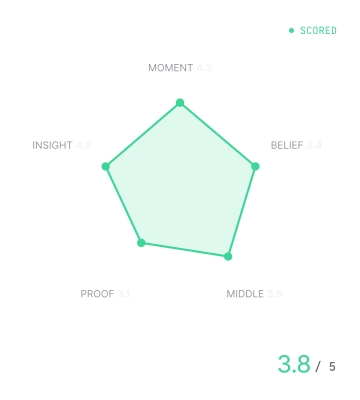
Would your draft pass this rubric?
Check what's true of your current draft. Be honest, the reviewer will be.
- I can point to one specific occasion where it started, not a season, year, or era
- My draft names a belief or behavior I held before, and what replaced it
- There are visible attempts or setbacks between the event and the lesson
- My new understanding is specific enough to quote, it couldn't close someone else's essay
- At least one concrete action after the growth period proves it stuck
Signal building. Over halfway — the missing dimensions are the ones readers weigh hardest.
Get the real scoreWhat Reviewers Look For:
Professional Doctorate Personal Statement (EdD/DBA/DNP/PsyD)
Professional Purpose and Doctoral Rationale
Evaluates whether the applicant articulates a specific professional problem or gap that necessitates doctoral-level preparation, rather than general career ambition. Strong responses name a concrete organizational or systemic challenge and explain why a professional doctorate is the appropriate instrument for addressing it.
Problem of Practice and Contextual Analysis
Evaluates the applicant's ability to define a bounded, real-world problem of practice with sufficient contextual specificity, including the organizational, community, or field setting in which it exists. Strong responses demonstrate that the applicant understands root causes, stakeholders affected, and the gap between current and desired conditions.
Leadership, Collaboration, and Evidence of Impact
Evaluates the applicant's track record of influencing change, building coalitions, or driving measurable outcomes in professional settings relevant to their stated problem. Strong responses cite specific initiatives led, roles held, and documented or observable results rather than general claims of leadership.
Applied Inquiry Approach and Feasibility
Evaluates whether the applicant demonstrates a realistic and methodologically informed plan for investigating their problem of practice within their professional context, including access to data, sites, and stakeholders. Strong responses indicate awareness of practitioner-research methods such as action research, improvement science, or program evaluation and acknowledge practical constraints.
Program Fit and Alignment with Learning Resources
Evaluates whether the applicant has done substantive investigation of the specific program and can articulate how particular faculty expertise, coursework, cohort structures, or applied project frameworks align with their problem of practice. Strong responses go beyond reputation to name concrete programmatic elements and explain why they are instrumental.
Community Contribution and Professional Judgment
Evaluates whether the applicant articulates how their doctoral work will generate value beyond personal advancement, including contributions to their professional field, organization, or community, and demonstrates mature practitioner judgment in assessing what is knowable and actionable. Strong responses situate the applicant as a steward of professional knowledge rather than a credential-seeker.
Career Path and Implementation Roadmap
Evaluates whether the applicant maps a coherent arc from current role through doctoral completion to a specific post-degree implementation scenario, demonstrating that the degree is an instrument for a defined professional transition or capability expansion. Strong responses include realistic timelines, named roles or organizational contexts, and a plausible theory of change linking doctoral learning to practice impact.
Writing Quality and Professional Credibility
Evaluates whether the prose conveys the precision, authority, and discipline-appropriate vocabulary of a practitioner ready for doctoral-level discourse, including sentence-level control, avoidance of vague abstractions, and consistency of voice. Strong writing signals that the applicant can produce the kind of practitioner-scholar communication the degree requires.
University of Pennsylvania DSW Application Essays
For the Doctor of Social Work in Clinical Practice program at the University of Pennsylvania School of Social Policy & Practice. Applicants are required to complete three essays of approximately 500 words each, engaging with questions of personal motivation, clinical case analysis, and a proposed area of doctoral inquiry.
7 DIMENSIONS1400-1600 WORDSOpen rubricPhD Research Proposal & Statement of Purpose
Tailored for research doctorate applications in which the defining evaluative signals are the intellectual viability of the proposed inquiry, the candidate's alignment with a prospective supervisor, and the logical rigour of the proposed execution plan.
8 DIMENSIONS1200-2200 WORDSOpen rubricPhD Statement of Purpose
A Statement of Purpose crafted for doctoral program applications, articulating your research background, theoretical orientations, intellectual alignment with prospective faculty, and capacity to advance original scholarship within your discipline
8 DIMENSIONS1000-1200 WORDSOpen rubric
Frequently asked questions
Quick answers about using the Professional Doctorate Personal Statement (EdD/DBA/DNP/PsyD) rubric.

Give the draft one more informed pass
Review the draft against its prompt, surface weak spots, and decide what to revise before submission.
Review your first draft