
PhD Research Proposal & Statement of Purpose Rubric
Tailored for research doctorate applications in which the defining evaluative signals are the intellectual viability of the proposed inquiry, the candidate's alignment with a prospective supervisor, and the logical rigour of the proposed execution plan.
- Dimensions8
- Score Range0–5
- Word Count1200 - 2200
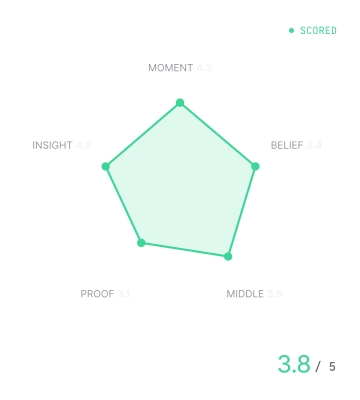
Would your draft pass this rubric?
Check what's true of your current draft. Be honest, the reviewer will be.
- I can point to one specific occasion where it started, not a season, year, or era
- My draft names a belief or behavior I held before, and what replaced it
- There are visible attempts or setbacks between the event and the lesson
- My new understanding is specific enough to quote, it couldn't close someone else's essay
- At least one concrete action after the growth period proves it stuck
Signal building. Over halfway — the missing dimensions are the ones readers weigh hardest.
Get the real scoreWhat Reviewers Look For:
PhD Research Proposal & Statement of Purpose
Articulating the Research Problem and Its Purpose
Evaluates whether the candidate articulates a specific, consequential problem and justifies why it demands doctoral-level investigation. Strong framing names the problem precisely, stakes its significance, and signals the candidate's ownership of it.
Situating the Work within the Scholarly Literature and Identifying the Gap
Evaluates whether the candidate maps relevant scholarly conversations accurately and locates a genuine, unoccupied gap rather than a restated debate. Strong positioning cites specific bodies of work, names their limits, and shows why the proposed study occupies distinct intellectual territory.
Coherence Between Research Questions and Methodological Design
Evaluates whether the stated research questions are answerable, scoped for doctoral work, and matched by a methodology that could plausibly generate the claimed answers. Strong coherence means questions, methods, and anticipated outputs form a logical chain with no broken links.
Feasibility, Scope, and Rigour of the Execution Plan
Evaluates whether the proposed study can realistically be completed within doctoral constraints of time, access, and resources. Strong execution plans include a phased timeline, identified data sources or field sites, and acknowledged contingencies.
Alignment with Prospective Supervisor and Research Environment
Evaluates whether the candidate demonstrates specific, informed reasons for targeting this program and supervisor, grounded in research overlap rather than institutional prestige. Strong alignment names the supervisor's relevant work, explains intellectual convergence, and references lab or center infrastructure that enables the proposed study.
Demonstrated Preparedness to Undertake Independent Research
Evaluates whether the candidate provides concrete evidence of prior research experience and the transferable skills it produced. Strong evidence names specific projects, methodological competencies acquired, and how past work informs the proposed study.
Contribution Pathway and Rationale for Doctoral Training
Evaluates whether the candidate articulates what the completed dissertation will add to the field and why a PhD is the appropriate vehicle for producing that contribution. Strong logic names the type of contribution — theoretical, empirical, methodological — and connects doctoral training to capacities the candidate does not yet have.
Clarity of Expression and Overall Proposal Coherence
Evaluates whether the document reads as an integrated intellectual argument rather than a sequence of disconnected sections, and whether disciplinary vocabulary is used accurately. Strong coherence means each section builds on the last, transitions carry argumentative logic, and technical terms are deployed with precision.
University of Pennsylvania DSW Application Essays
For the Doctor of Social Work in Clinical Practice program at the University of Pennsylvania School of Social Policy & Practice. Applicants are required to complete three essays of approximately 500 words each, engaging with questions of personal motivation, clinical case analysis, and a proposed area of doctoral inquiry.
7 DIMENSIONS1400-1600 WORDSOpen rubricProfessional Doctorate Personal Statement (EdD/DBA/DNP/PsyD)
Tailored for candidates pursuing a professional doctorate, this rubric assesses the clarity and sophistication of problem-of-practice framing, the depth of leadership impact, the viability of the proposed project, and the coherence of alignment with the selected program.
8 DIMENSIONS1000-1500 WORDSOpen rubricPhD Statement of Purpose
A Statement of Purpose crafted for doctoral program applications, articulating your research background, theoretical orientations, intellectual alignment with prospective faculty, and capacity to advance original scholarship within your discipline
8 DIMENSIONS1000-1200 WORDSOpen rubric
Frequently asked questions
Quick answers about using the PhD Research Proposal & Statement of Purpose rubric.

Give the draft one more informed pass
Review the draft against its prompt, surface weak spots, and decide what to revise before submission.
Review your first draft