
Poland National Visa Cover Letter Rubric
For applicants pursuing a Polish national visa (Type D): compose a cover letter of 600–1,000 words that articulates with clarity the purpose and intended duration of your stay, provides a compelling justification for your chosen programme, demonstrates sound financial preparedness, and makes deliberate reference to the supporting documentation enclosed within your application.
- Dimensions6
- Score Range0–5
- Word Count600 - 1000
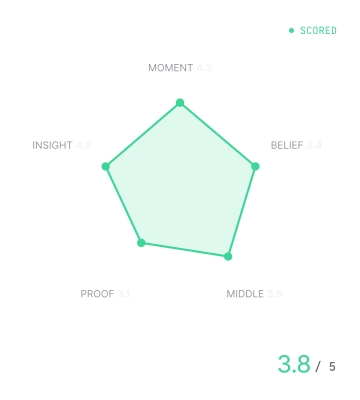
Would your draft pass this rubric?
Check what's true of your current draft. Be honest, the reviewer will be.
- I can point to one specific occasion where it started, not a season, year, or era
- My draft names a belief or behavior I held before, and what replaced it
- There are visible attempts or setbacks between the event and the lesson
- My new understanding is specific enough to quote, it couldn't close someone else's essay
- At least one concrete action after the growth period proves it stuck
Signal building. Over halfway — the missing dimensions are the ones readers weigh hardest.
Get the real scoreWhat Reviewers Look For:
Poland National Visa Cover Letter
Purpose and Motivation for Study
Evaluates whether the applicant articulates a specific, credible reason for pursuing this programme at this time, linking personal or professional history to the decision. Strong responses name the field, explain the gap the programme fills, and connect study goals to concrete next steps.
Academic History and Programme Suitability
Evaluates whether prior qualifications and experience logically lead to the chosen programme, and whether the applicant demonstrates knowledge of specific modules, faculty, or entry requirements. Strong responses show alignment between past credentials and programme demands without generic praise of the institution.
Reasons for Choosing Poland and the Institution
Evaluates whether the applicant provides substantiated, institution-specific reasons for choosing Poland as a study destination and this particular university over alternatives. Strong responses cite verifiable institutional features — research centres, bilateral agreements, language of instruction, faculty expertise — not general country reputation.
Financial Preparation and Practical Arrangements
Evaluates whether the applicant specifies the funding source, estimated costs, and how funds are secured, referencing attached financial documents. Strong responses name the sponsor or account holder, indicate the amount available, and acknowledge tuition and living cost estimates with document cross-references.
Ties to Home Country and Intent to Return
Evaluates whether the applicant presents credible, specific evidence of ties to their home country that establish intent to return after the visa period. Strong responses cite employment offers, family obligations, property, or professional licences that create concrete incentive to return, not abstract statements of loyalty.
Awareness of Documents and Honest Disclosure
Evaluates whether the applicant explicitly references attached documents by name or label within the letter body and demonstrates awareness of the visa application requirements. Strong responses integrate document references naturally at relevant claims — financial, enrolment, accommodation — rather than listing them only at the end.
Ireland Student Visa — Personal Statement of Purpose
For applicants pursuing an Irish student visa (ISD): a carefully composed personal statement of 500–1,000 words articulating your motivations for study, pertinent academic history, the suitability of your chosen programme, evidence of adequate financial support, meaningful ties to your home country, and a clear intention to return upon the completion of your studies.
6 DIMENSIONS500-1000 WORDSOpen rubricGenuine Student Statement — Australia
For applicants seeking an Australian student visa (Subclass 500): compose four concise responses (approximately 150 words each) addressing your current personal circumstances, your rationale for selecting this course of study, the anticipated impact on your professional trajectory, and any supplementary context you consider pertinent.
6 DIMENSIONS400-600 WORDSOpen rubricGermany Student Visa – Motivation Letter
Tailored for applicants seeking a German student visa through an embassy or consulate: a motivation letter of 500–700 words that articulates your reasons for pursuing study, your academic background, your rationale for selecting this particular program, your plan for financing your studies, and your intentions to return to your home country upon completion. This document is distinct from the Motivationsschreiben submitted to the university as part of the admissions process.
6 DIMENSIONS500-700 WORDSOpen rubricGlobal Korea Scholarship (GKS) Application — South Korea
For candidates pursuing the Global Korea Scholarship (GKS/KGSP): a self-introduction and a study plan (approximately 1,000 words each) that together articulate personal background, motivation for applying, academic objectives, and intended impact following graduation.
6 DIMENSIONS2000-3000 WORDSOpen rubricSwitzerland Student Residence Permit Motivation Letter
Crafted for students seeking a Swiss student residence permit through a cantonal migration authority: a compelling motivation letter of 300–800 words that thoughtfully addresses academic objectives, prior educational background, financial circumstances, housing arrangements, and an unambiguous commitment to departing Switzerland upon the conclusion of studies.
6 DIMENSIONS300-800 WORDSOpen rubricBelgium Student Visa Support Letter
For applicants pursuing a Belgian Type D student visa: a carefully composed support letter addressing the three essential IBZ questions — your rationale for selecting this particular programme, your reasons for choosing Belgium as your destination, and the personal and professional benefit you anticipate gaining — rendered with clarity and conviction in 500–700 words.
6 DIMENSIONS500-700 WORDSOpen rubricItaly Student Visa — Personal Statement of Purpose
For applicants pursuing an Italian long-stay student visa (Type D): compose a focused personal statement of approximately 400–500 words — the equivalent of one page — that thoughtfully articulates your motivations for undertaking this course of study, your rationale for selecting this particular programme, your relevant academic background and preparation, and the means by which your studies will be financially sustained.
5 DIMENSIONS300-500 WORDSOpen rubricStatement of Genuine Intent — New Zealand
For applicants seeking a New Zealand student visa through Immigration New Zealand (INZ): a formal cover letter articulating your authentic motivation to pursue study, substantiating your choice of programme, detailing your financial provisions, and outlining your intended course of action upon completing your studies, composed within 500–800 words.
6 DIMENSIONS400-800 WORDSOpen rubricCanada Study Permit – Letter of Explanation
For applicants seeking a Canadian study permit through IRCC: a letter of explanation that compellingly establishes genuine intent to pursue academic study, articulates the rationale behind the chosen program, demonstrates financial preparedness, and evidences meaningful ties to the applicant's home country — composed within 500–1,000 words.
6 DIMENSIONS500-1000 WORDSOpen rubricCampus France Motivation Statement — France
For applicants submitting through the Campus France (Études en France) platform: a rigorously distilled motivation statement (approximately 155 words) that thoughtfully addresses academic background, the reasoning behind program selection, and the intended professional or academic trajectory.
5 DIMENSIONS100-200 WORDSOpen rubric
Frequently asked questions
Quick answers about using the Poland National Visa Cover Letter rubric.

Give the draft one more informed pass
Review the draft against its prompt, surface weak spots, and decide what to revise before submission.
Review your first draft